
Why the money has to be accounted for.
Sponsorship is company money spent at a racetrack, usually a long way from the office. This page explains why that needs a proper record behind it, where it usually goes wrong, and what we do differently.
It's a marketing cost, so it has to look like one.
When a company pays for advertising, that's an ordinary business expense, treated like any other marketing spend, and the VAT on the invoice is handled the way it is for any other supplier. When a company pays for a day out for its customers, that's business entertainment, and the rules are different: entertaining customers is generally not a deductible cost, and the VAT on it generally can't be claimed back. Those aren't our rules and we don't give tax advice. But they are the reason advertising and hospitality must never be mixed up in the same figure, and the reason the record of what you actually bought matters so much.
Sponsorship at this level is usually paid informally. Money goes to a driver or a team, a logo goes on the car, and there's no agreement, no deliverables and nothing dated to show what the company got. If anyone later asks what the money was for, the honest answer is "we helped a lad go racing", and that is a much harder thing to stand behind as marketing than an advertising agreement with the evidence attached.
Where it usually goes wrong.
1. Nothing in writing. The money goes across on a handshake. There's no description of what was bought, for how long or at what price, so nobody can show it was a commercial arrangement rather than a gift.
2. One figure for everything. Advertising, tickets, a suite for the day and a contribution to the running costs, all rolled into one payment, or paid straight to an individual with no invoice at all. When each part is treated differently, one number is a problem for whoever has to account for it.
3. Nothing to show it happened. The car raced, or it didn't. Nobody took a dated photograph of your name on it, and the season is over before anyone thinks to look.
4. A personal connection and no commercial logic. Backing a friend's team, or a family member's, is a perfectly good reason to be involved. But if the paperwork looks like a favour rather than advertising priced on a commercial basis, your accountant will treat it as a favour, and so will anyone else who looks at it.
5. Money that can't be traced. Payments to individuals, in cash or through informal accounts, with no VAT invoice behind them, are hard to account for and easy to question.
What we do about it.
We can't decide how your company treats the spend. That's your accountant's job, and we stay out of it. What we can do is make sure the records they need exist, and that they say what actually happened.
- A written agreement, priced commercially. What runs, where, for how long and at what price, agreed before any money changes hands. The same commercial basis for every customer, whoever introduced you to us.
- Advertising and hospitality on separate lines. Your invoice shows the advertising placements on one line and any race-day hospitality on another, with VAT shown on each. Nothing is bundled, so each part can be treated correctly.
- A dated record every quarter. Which cars and bikes carried your name, at which circuits, on which dates, with the photographs to prove it and every invoice matched to a line in the report.
- You pay a company, not a person. SPONSR invoices you, and SPONSR pays the teams and the photographers. The money can be followed from your accounts to what was delivered.
- Answers on request. If your accountant has a question about what was supplied, when and under what terms, we answer it with the documents above, not from memory.

This is what a quarter looks like on paper.
The spread shown here is an illustrative sample of the report format, not a real client's report.




Illustrative sample.
What the report brings together.
- Dated photographs. Your name on the cars and bikes, taken at the circuit, each one dated.
- The machines. Which cars and bikes carried your name, and in which championships.
- The circuits and dates. Where each placement ran, and when.
- Your race days. Hospitality that ran in the quarter, with dates and guest counts.
- What changed. If something changed or was missed, that goes in too, along with what happens next under your agreement.
- The invoices. Every invoice behind the quarter's work, matched to the lines in the report.
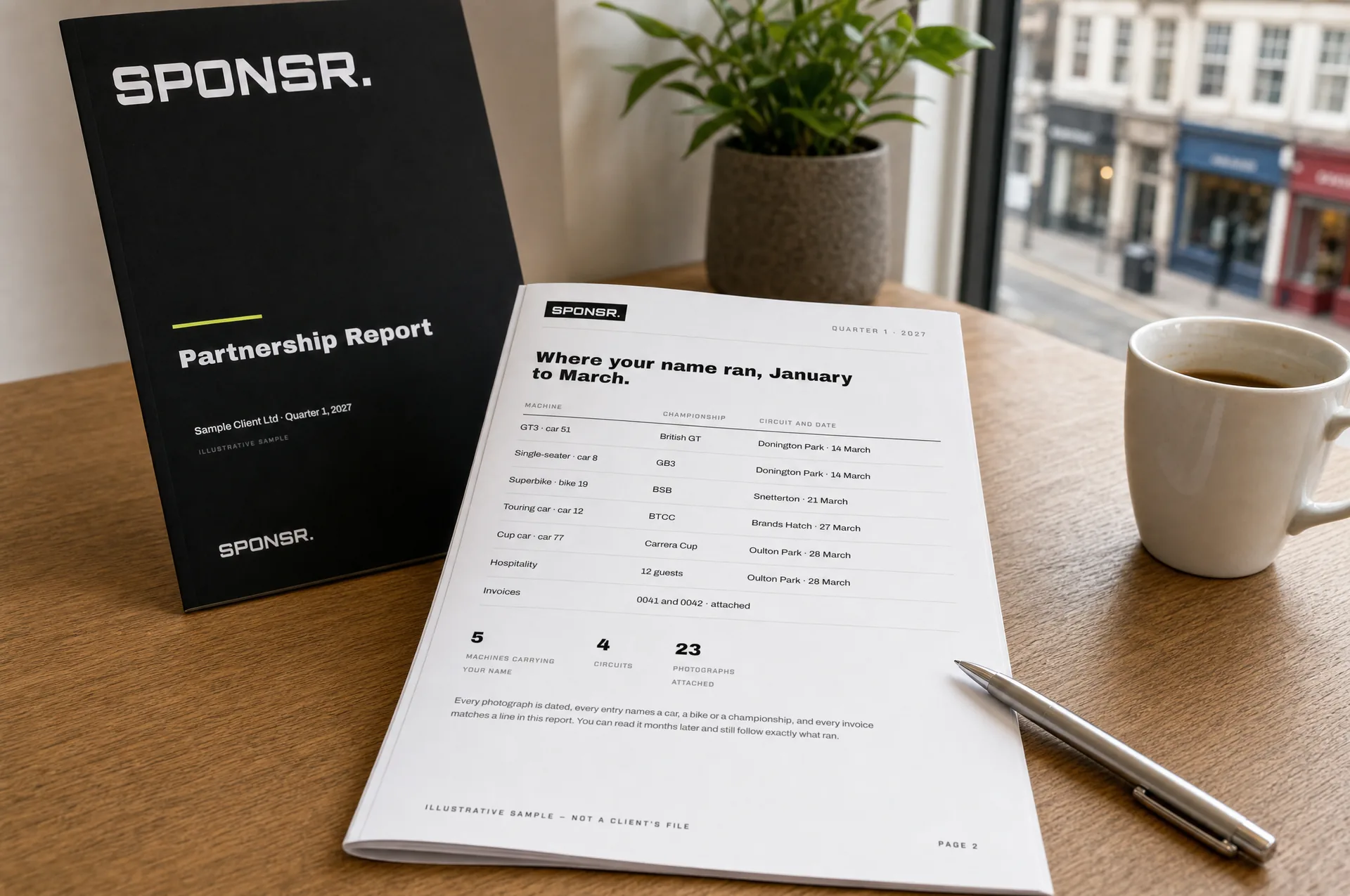
The paperwork behind it.
Three documents go together: the agreement, which says what runs, where and for how long; the invoice for the period; and the quarterly record, which shows what actually ran against that agreement. Each one refers to the others, so your accountant can follow the money from what was agreed to what was delivered. The documents shown here are illustrative samples, not a client's file.
What we don't do.
We don't tell you what your company can claim, and we don't promise a tax result. Anyone in this business who does is selling something they can't deliver. We report what ran, where and when. We don't estimate how many people saw it, and we don't promise what it will do for your sales. The assessment is your accountant's to make, and this page is written so they can make it.
Pass this page to your accountant, or ask us directly.
Questions about what's supplied and how it's recorded are welcome before anything is signed. Tell us where you trade and roughly what you'd like to spend, and we'll show you what a quarter like this would look like for your business.